The Keys of the Kingdom: Perugino’s Christ Giving the Keys to St Peter illustrating the Anglican View of the Petrine Office
A note on the Gospel reading for the Thirteenth Sunday after Pentecost — Proper 16A, Year A — 23 August 2026 -- Matthew 16:13-20
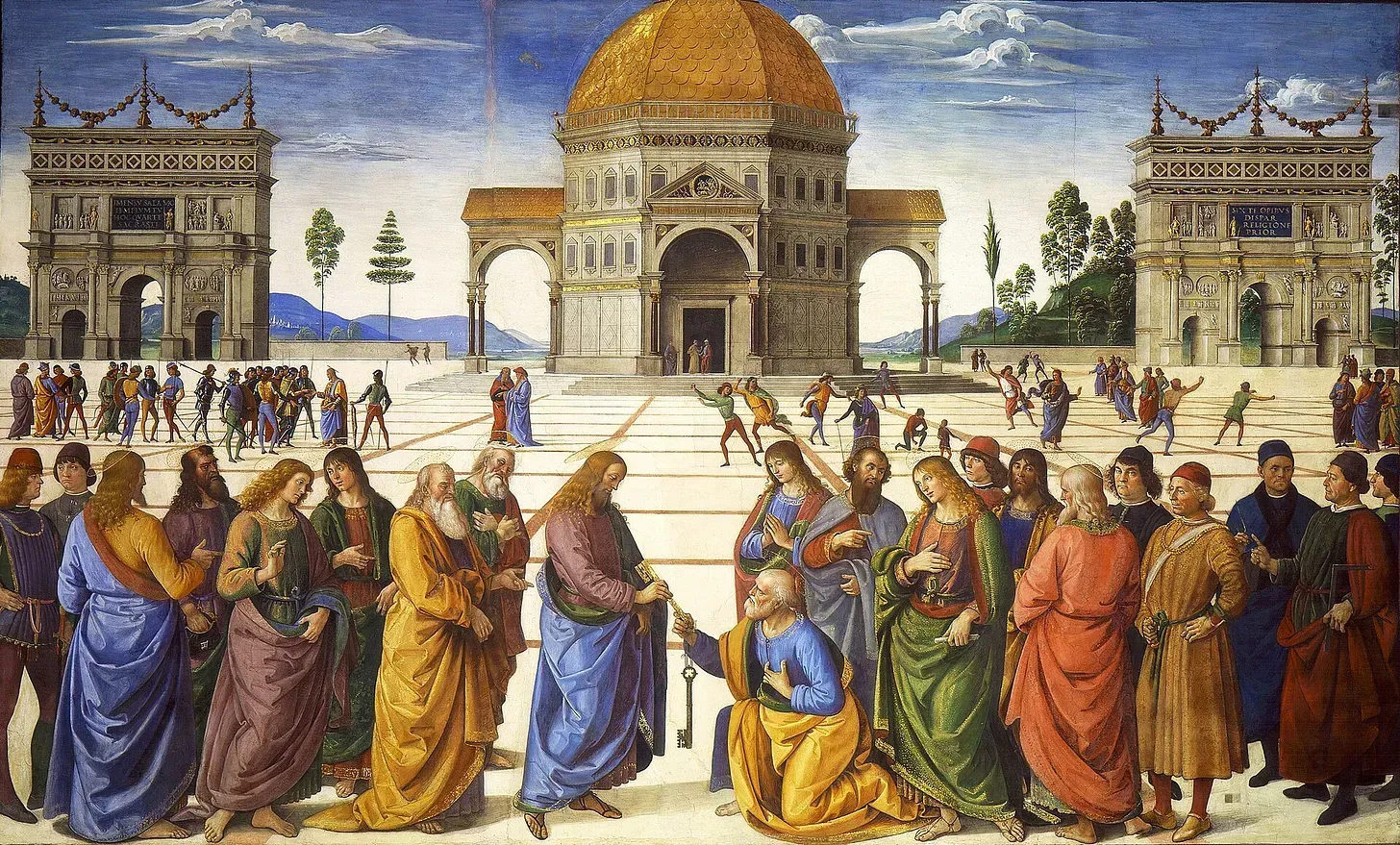
Pietro Perugino, Christ giving the keys to St Peter, (1481-2) Sistine Chapel, Rome
After you take your eyes off the ceiling, turn to the north wall of the Sistine Chapel. Pietro Perugino’s fresco Christ Giving the Keys to Saint Peter, painted in 1481–82, is nearly eleven feet high and eighteen feet wide. Sixtus IV commissioned it. The chapel would one day hold Michelangelo’s ceiling. This picture came first.
The composition is calm and open. A wide paved square recedes toward a domed octagonal temple in the middle distance. Two Roman triumphal arches flank it. Feathery trees and blue hills close the horizon. It is a Renaissance idea of order. Everything is measured.
In the foreground a long line of figures stretches across the whole width. Near the center Christ stands, facing right. He wears a dusty rose tunic and a heavy blue mantle wrapped from the waist down. His hair is long and parted. His feet are bare. From his right hand he holds out two keys by their bows — one large and gold, one behind it in silver.
Peter kneels on both knees in front of him. He is older, balding on top, with a full white beard. He wears a heavy yellow-gold outer robe over a blue undergarment. His left hand is pressed to his chest. His right hand has already closed on the keys, his fingers touching Christ’s fingers at the bow. The handoff is happening. He is receiving them from a hand.
Around them, in a tight frieze across the foreground, stand the other apostles. Robes of blue, wine, russet, and green. All haloed. Some watch the exchange. Some talk quietly to one another. At each end of the row stands a small cluster of men in Renaissance dress, without halos. These are contemporary Florentines, patrons and painters. Perugino has put himself among them, at the far right. The kingdom, he seems to say, has room for all sorts.
Now go to the Gospel Sunday’s reader will read.
Jesus and his disciples have withdrawn to Caesarea Philippi in the far north. Gentile territory where Jesus would have seen shrines of Pan cut into the rock face of mountains and a Roman city named for the emperor. And in that foreign place, of all places, Jesus asks the disciples the question. Who do people say that the Son of Man is? They answer: Some say John the Baptist. Some say Elijah. Some say Jeremiah or one of the prophets.
Then Jesus asks the second question. But who do you say that I am? Peter answers. You are the Christ, the Son of the living God.
And Jesus says the sentence Perugino spent months painting. Blessed are you, Simon Bar-Jona! For flesh and blood has not revealed this to you, but my Father who is in heaven. And I tell you, you are Peter, and on this rock I will build my church, and the powers of death shall not prevail against it. I will give you the keys of the kingdom of heaven.
What has Jesus done? He renames a man. Simon becomes Peter — petros, stone. He founds a Church. He hands over authority. He commits himself to a body that will outlast the world.
And to whom does he do this? To a fisherman from Galilee who has just answered one question correctly. A man who, before this chapter is over, will be told, Get behind me, Satan. A man who, by the end of the Gospels, will deny his Lord three times in a courtyard.
That is the picture Perugino has painted. Not a great man being crowned. An older fisherman on his knees, one hand at his chest and the other closing on keys he did not forge.
There has been a long fight in the Church about that fresco. Rome reads the keys one way. Geneva reads them another. As an Anglican I read what the collect for the day reads. Grant, O merciful God, that your Church, being gathered together in unity by your Holy Spirit, may show forth your power among all peoples. The Church is gathered together. It is gathered by the Spirit. Its power is not its own. The keys are Christ’s before they are Peter’s.
Article XIX of the Articles of Religion says the visible Church of Christ is a congregation of faithful men in which the pure Word of God is preached and the sacraments duly ministered. Article XX says the Church has authority — but not against the Word. The keys open the Kingdom by the Gospel and close it against unbelief and impenitence. They are not a private treasure. They are the ministry of Word and Sacrament, given to the whole Church through her ministers, for the sake of sinners.
Richard Hooker in his fifth book of the Laws says the visible Church is the school where God brings men to Christ. Cranmer in the daily office puts the keys in your hands every morning. When the priest says Almighty God, our heavenly Father, who of his great mercy hath promised forgiveness of sins, Peter’s keys are turning in the lock. When the deacon reads the Gospel and the congregation stands, the keys are being handed on. When we baptize a child at the font, the keys have been used. When we come to the rail, the keys have been used.
That is why Perugino painted the keys as large as Peter’s forearm. They are the whole point.
Now the applications.
First, do not put more weight on Peter than the text does. Peter is not the Church. He is a member of it. He kneels. He receives. He does not stand and hand out. The keys are Christ’s. Any bishop, any priest, any parish that forgets this is trying to melt down the metal for its own ring.
Second, do not put less weight on the keys than the text does. Jesus said what he said. He founded a Church. He gave authority. Do not be embarrassed by the fact that Christ commits his kingdom to human hands. He does. He has done so from the beginning. He is doing so this morning, in every parish that reads the Gospel and breaks the bread.
Third, when you come to confession — general confession in the pew or particular confession to a priest — believe the words that follow. When the priest pronounces absolution he is turning a real key. Not his key. Christ’s. Do not walk out of church wondering whether it took. It took.
Fourth, when you preach or teach — in the pulpit, in the Sunday school, at your kitchen table with a child — remember what your mouth is doing. It is turning a key. Handle it soberly. Do not open the kingdom to sin and do not close it against contrition.
Fifth, look at your own hands the way Peter’s are painted. One at the chest. One reaching. You did not earn what is being placed in the reaching hand. You are being handed what you cannot forge. Confess him again this morning. You are the Christ, the Son of the living God. Say it plainly. Say it before you receive the Bread.
The keys are in the fisherman’s hands. Come, and be let in.
Readings for the Thirteenth Sunday after Pentecost, Proper 16A, Year A, on lectionarypage.net: Exodus 1:8–2:10; Psalm 124; Romans 12:1-8; Matthew 16:13-20. Artwork: Pietro Perugino, Delivery of the Keys, 1481–82, fresco, 330 × 550 cm, Sistine Chapel, Vatican City. Working sources: Articles of Religion XIX–XX; Richard Hooker, Of the Laws of Ecclesiastical Polity, Book V; the Collect and General Confession, 1979 BCP.