The Architecture of the Lord's Prayer (Adult Education at Shepherd of the Hills Episcopal Church, Lecanto, FL)
The Architecture of the Lord's Prayer-Chiastic Structure in the Lord's Prayer
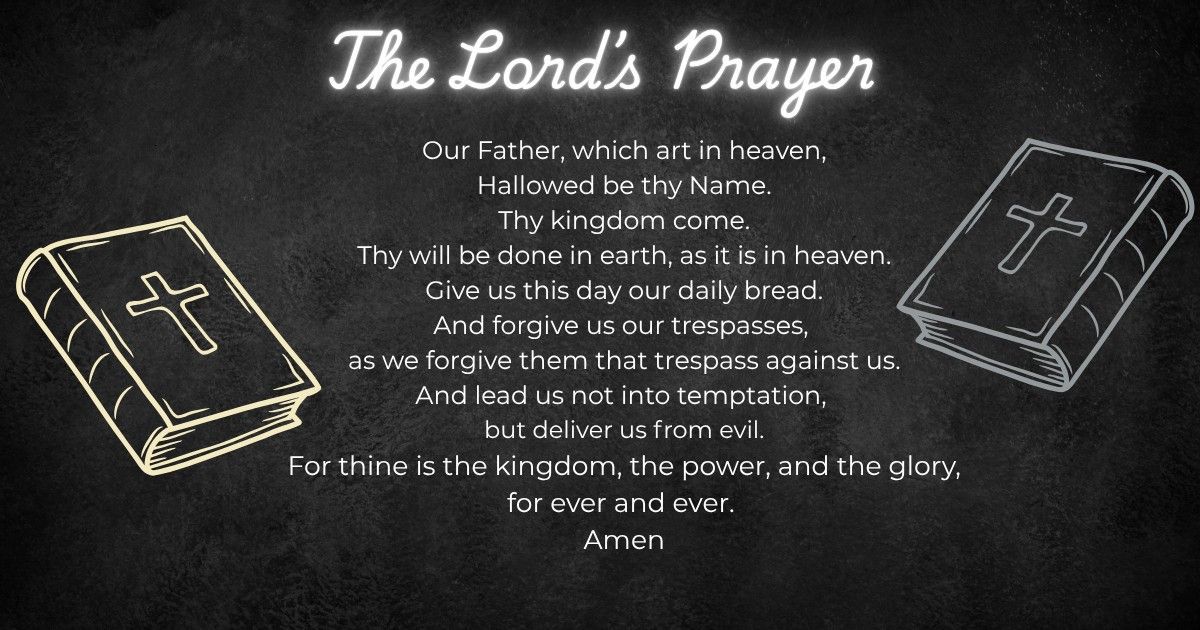
Class Outline at a Glance
Introduction — the confession; prayer as architecture
What is a chiasm? Definition, Hebrew provenance, center-as-point principle
Macro-level: Lord's Prayer as center of the Sermon on the Mount
Structure 1: The Seven-Petition Chiasm (Wenham / Meynet) + epiousios
Structure 2: The Forgiveness Chiasm — volitional statement; Matt 6:14–15
Structure 3: The Doxological Ring — manuscript history; BCP context
Sources
Introduction
Good morning. The topic for this Sunday’s class comes from a question a parishioner raised, about the petition to forgive our sins, as we forgive the sins of others in the Lord’s Prayer. She wanted to know where this stood in relation to the other petitions of the Lord’s Prayer. How did Jesus’ disciples hear it? How should we hear it?
And then, a friend, Dr. Gavin Ashenden, posted an article on his substack page, The New English Catholic, discussing the structure of the Lord’s Prayer – its architecture. That led me to thinking and reading – but first let me start with a confession.
I have said the Lord's Prayer — by a very rough estimate — somewhere between fifteen and twenty thousand times in my life. That number is probably conservative. Morning Prayer, Evening Prayer, the Eucharist, baptisms, funerals, hospital rooms at two in the morning, and countless Sundays where I was standing at the altar on autopilot while my brain was composing the announcements.
And for most of that time, I treated it the way you treat a very familiar piece of music. You know it so well you stop hearing it. You know the shape of it, the sound of it, but the actual content — the specific, intentional, theologically loaded content — has gone quiet. What I want to do this morning is make it loud again.
Not by adding anything to it. Not by giving you a new translation or a new interpretation or a new spiritual exercise. But by helping you see something that was already there — something that was there when Jesus first taught it, something that the early church noticed and the medieval church preserved and that modern biblical scholarship has in the last generation worked very hard to describe with precision.
The Lord's Prayer is not just a prayer. It is an architectural object. It has a structure — a deliberate, sophisticated, carefully crafted literary structure — and when you see that structure, the prayer does not become different. It becomes deeper. The words you already know start doing something new.
The single sentence to hold for the next 30 minutes:
"The Lord's Prayer is the center of the Sermon on the Mount, and it has its own center, and once you see where that center is, everything else in the prayer reorganizes itself around it."
What Is a Chiasm?
A chiasm — from the Greek letter chi, which looks like our letter X — is a literary device in which a sequence of ideas is stated and then repeated in reverse order. The name comes from the way the pattern crosses itself. You go out and then come back.
The simplest example I know comes from Genesis 9:6: "Whoever sheds the blood of a human, by a human shall that person's blood be shed." In Hebrew, the words arrange themselves: blood / man / sheds / sheds / man / blood. It crosses at the center. That is a chiasm.
But chiasm can operate at much larger scales. It can organize a paragraph, a chapter, a whole book. And the crucial thing — the thing that makes this theologically interesting rather than just formally interesting — is this: In a chiasm, the center is the point. Everything before it leads toward it. Everything after it echoes back from it. The center is the destination.
This is not a Greek device, I should say. It is native to Hebrew poetry and prose. It runs through the Psalms, the prophets, the narrative portions of the Torah. When Matthew is writing a gospel for a Jewish-Christian audience, he is writing for people who are trained — even unconsciously — to read this way. They expect structure. They expect mirroring. They know that when a teacher sets a pattern, the center is where you should focus.
The Lord's Prayer as Center of the Sermon on the Mount
Matthew chapters five, six, and seven are the Sermon on the Mount. Scholars who study the Sermon's architecture — Jonathan Pennington at Southern Seminary is one of the most recent; Ulrich Luz, the great Swiss commentator, laid much of the groundwork — have identified a chiastic structure in the Sermon as a whole. The exact contours are debated, but the convergence is striking:
By almost every reconstruction, the Lord's Prayer falls at or very near the center of the Sermon on the Mount.
Sermon on the Mount (Matthew 5–7)
↳ Section on prayer (Matthew 6:1–18)
↳ Teaching on prayer (Matthew 6:7–15)
★ The Lord's Prayer (Matthew 6:9–13) — THE CENTER
That phrase — "the center of the center of the center" — should stop you. Matthew was not an accidental writer. When he places the Lord's Prayer precisely here, he is telling you what he thinks the Sermon is about. Tertullian, writing in the early third century, saw this instinctively. He called the Lord's Prayer breviarium totius evangelii — "an epitome of the whole gospel." He meant it theologically, but he was also seeing the structural logic Matthew had built. This prayer is not inside the Sermon on the Mount. The Sermon on the Mount is around the prayer.
The Internal Chiastic Structures
There are three main proposals I want to walk you through. They are not mutually exclusive — more like three different photographs of the same building. Each illuminates something the others may not fully capture.
1. The Seven-Petition Chiasm (Wenham and Meynet)
David Wenham — a British New Testament scholar, writing in the Expository Times in 2010 — and Roland Meynet, a French Jesuit and scholar of biblical rhetoric, arrived independently at a similar reading. The proposal: petitions one, two, and three form a unit oriented toward God — his name, his kingdom, his will.
Petitions five, six, and seven correspond, oriented toward our struggle with evil — our debts, our temptations, our need for deliverance. And petition four — daily bread — sits at the center.
Petition (opening half) Mirror (closing half)
A (1) Hallowed be thy name A' (7) Deliver us from evil
B (2) Thy kingdom come B' (6) Lead us not into temptation
C (3) Thy will be done on earth as it is
in heaven
C' (5) Forgive us as we forgive
★ (4) Give us this day our daily bread
[ C E N T E R ]
The Paired Petitions
Pair Wenham / Meynet (Seven-Petition) Significance
A / A’ Hallowed be thy name ↔ Deliver us from evil The holy name of God against the reality of the evil one — the outer frame of all Christian prayer
B / B’ Thy kingdom come ↔ Lead us not into temptation
The eschatological kingdom and the eschatological conflict that precedes its full arrival — two sides of one reality
C / C’ Thy will be done on earth as it is in heaven ↔
Forgive us as we forgive
Both petitions contain an "as" clause — God's macro-will on earth takes the specific shape of forgiveness between persons
★ Center Give us this day our daily bread (epiousios) Physical bread + Eucharistic bread + bread of the coming kingdom — the eschatological and sacramental hinge
Meynet compared this arrangement to the seven-branched candlestick — the menorah — where all six branches angle toward the central flame. The center is not incidental; it is what the whole structure is lit by. The Word at the Center: ἐπιούσιος (epiousios)
This is one of the most discussed single words in the New Testament — and for good reason. It appears only twice in all of ancient Greek literature, both times in the Lord's Prayer: Matthew 6:11 and Luke 11:3. Origen, writing in the third century, noted that it appeared to be a Matthean neologism. He suggested it meant "what is necessary for existence."
Jerome, when he translated the New Testament into Latin in the late fourth century, handled the word differently in each gospel. In Matthew, he rendered it supersubstantialis — supersubstantial, above substance, beyond merely material. In Luke, he used the simpler quotidianum — daily. From very early on, the church was reading this word two different ways simultaneously.
Three registers — all at once (Benedict XVI, Jesus of Nazareth, ch. 5)
1. Physical: Bread for today — daily dependence on God, trust without reservation
2. Eucharistic: The Body of Christ as the true bread of life
3. Eschatological: The bread of the age to come — already given in the Eucharist as anticipation and pledge Tertullian, writing two centuries before Jerome, already reads this petition eucharistically: "Christ is our bread. In petitioning for daily bread, we ask for perpetuity in Christ, and indivisibility from his body." That is not a late medieval development. That is second-century North Africa.
If Wenham and Meynet are right — if daily bread is the center of a chiastic prayer that is itself the center of a chiastic Sermon on the Mount — then Matthew is saying that the Eucharist, physical sustenance that is also eschatological foretaste, is the hinge on which the whole ethical vision of the Sermon turns. "Give us this day our daily bread" is not the most modest petition in the prayer. It may be the most audacious.
2. The Forgiveness Chiasm
The second proposal focuses on a different center — confirmed by something Matthew does that is unusual. He adds a commentary.
Look at Matthew 6:14–15, immediately after the prayer:
"For if you forgive others their trespasses, your heavenly Father will also forgive you; but if you do not forgive others, neither will your Father forgive your trespasses." Matthew is a careful literary craftsman. He does not comment on other petitions. He does not say "and of course mean it when you say hallowed be thy name." He does not explain the eschatology behind thy kingdom come. The only thing he stops to reinforce — with a conditional that is strikingly sharp — is forgiveness. And within the prayer itself, there is something unique about the forgiveness petition that distinguishes it from every other line. Every other petition is a request.
But the forgiveness petition contains the only volitional statement in the prayer made by the person praying: "...as we forgive those who trespass against us." This is the only line in the prayer where the one praying makes a claim — a commitment, a self-declaration — rather than a request. Present tense: we forgive. Not "we will try." As we forgive. The logic is as alarming as it is obvious: you are asking God to treat you as you treat others. Matthew will not leave this alone — returning to it in 6:14–15 functions structurally as a bracket. The prayer is surrounded by the theme of forgiveness.
Opening petitions
A Our Father ... hallowed be thy name
B Thy kingdom / will be done
C Give us daily bread (physical dependence)
★ Forgive us — as we forgive (volitional commitment)
Mirror petitions
A' Doxology: power and glory forever
B' Deliver from temptation / evil
C' Lead us not into temptation (spiritual dependence)
★ ← moral hinge; expanded in Matt 6:14–15
For us, liturgically, this is a serious word. When we stand in the nave and say the Lord's Prayer together, we are collectively making a claim: as we forgive our debtors. The prayer is asking: what kind of community are you, really?
3. The Doxological Ring
The third structure is the most contested, because it requires taking seriously something the critical text of Matthew leaves out. "For thine is the kingdom, and the power, and the glory, forever and ever. Amen."
These words do not appear in the earliest Greek manuscripts. They are absent from the Codex Vaticanus, the Codex Sinaiticus, and most of the critical witnesses. Modern translations, including the NRSV, omit them or relegate them to a footnote. The critical consensus is that they are a liturgical addition — probably very early, probably appropriate, but not original to Matthew 6. And yet.
The Didache — the late first or very early second century church manual, one of the most important witnesses to early Christian practice we possess — includes a doxology and instructs communities to pray the Lord's Prayer three times daily. The doxology is built into practice from the beginning.
The Doxological Ring
OPENING: "Our Father, who art in heaven..."
Hallowed / Kingdom / Will → God's glory and sovereignty
[Petitions for bread, forgiveness, deliverance]
Kingdom / Power / Glory → God's sovereignty and glory
CLOSING: "For thine is the kingdom, and the power, and the glory..." The very attributes that make the petitions possible — God's sovereignty, God's power, God's glory — are named at the close as the reason the prayer works. Notice what this does to the outer frame: petition one is "hallowed be thy name," and the doxology ends with "the glory, forever." The name of God and the glory of
God bracket the entire prayer. The evil one, petition seven, is the only element that falls outside the doxological ring — which is, theologically, exactly where he belongs.
In the 1979 Book of Common Prayer — the one we worship with — the doxology appears in both Rite I and Rite II: Morning Prayer (pp. 54, 97), Evening Prayer (pp. 63, 116), and the Eucharist (pp. 336, 364). Cranmer, when he wrote the 1549 Prayer Book, was insistent that the Lord's Prayer be said not once but twice in Morning Prayer and Evening Prayer. Part of the logic was precisely this: it is not an ornament to the liturgy. It is a spine. It is load-bearing.
For those of us who are Anglicans, the doxological ring is not a textual accident. The critical scholars are right that it is a liturgical addition. But liturgical additions are not corruptions. They are the church responding to something structurally incomplete and completing it. The congregation has been, for two thousand years, finishing the architecture.
Theological Implications and Pastoral Applications
1. This prayer is not vain repetition.
Matthew 6:7 warns against battalogeo — babbling, mechanical repetition without meaning. The Lord's Prayer, as we have been seeing, is the opposite of meaninglessness. It is a structure of intense density. Every petition is load-bearing. Every word is placed. The fact that you say the same words on Tuesday that you said on Monday is not meaninglessness — it is returning to a map. The map does not become less accurate because you read it more than once. When you understand where you are in the prayer's architecture, saying familiar words becomes an act of navigation.
2. The structure tells you what to linger on.
Adult Education — Shepherd of the Hills Episcopal Church If you want to pray the Lord's Prayer with attention rather than on autopilot, the chiastic structure gives you a map for contemplation. Take a week on each of the seven petitions. Hold the pairs together. Pray petition one and petition seven side by side: what does it mean that the holy name of God and the reality of evil are the
outer frame of Christian prayer? Sit with petition three and petition five — the two "as" clauses. God's will being done on earth takes a specific shape: forgiveness between persons. This is not abstract. This is about specific people in your life, named and unnamed.
And sit at the center. The epiousios bread. Ask honestly: when you say "give us this day our daily bread," what are you actually asking for? Physical food? The Eucharist? The bread of the coming kingdom? All three? Tertullian says all three. Jerome's two translations were both grasping for the same untranslatable word. That is a word worth sitting with.
3. Knowing this structure changes what the Eucharist feels like.
If the Lord's Prayer is at the center of the Sermon on the Mount, and the center of the Lord's Prayer is bread — specifically, eschatological, Eucharistic bread — then every time we celebrate the Eucharist, we are standing at the theological center of the Sermon on the Mount. We are at the center of the center of the center.
We are, every Sunday, receiving the answer to the prayer Jesus taught us to pray.
4. The forgiveness petition is the only line you have to mean.
Every other petition is something you are asking God to do. But in the forgiveness petition, you are making a claim. Origen struggled with this. Chrysostom, in his homilies on Matthew, spends considerable time on what it means that the petition is conditional — and he does not soften it. He says: this is what it is. You are asking God to be toward you what you are toward others. That is alarming. It should be alarming. It is intentional. The one place in the prayer where you are not a recipient but an actor is also the place where the stakes are highest. The prayer is asking the congregation a diagnostic question about its own life together.
Closing
There is a pattern in the Hebrew prophets of placing the most important thing in the most structurally prominent position — not so that people will find it easily, but so that when they find it, they will know they have arrived somewhere. It is like an architect who buries the load-bearing beam inside the wall. You do not see it until someone points to it, and then you realize: that is why the building stands.
The chiastic structure of the Lord's Prayer functions the same way. When you pray it in the liturgy — in the Daily Office, at the Eucharist, at a graveside — you are running an architecture. You are standing at the center of something that the church has been inside for two thousand years, that the Sermon on the Mount was organized around, that Tertullian called the epitome of the whole gospel.
Every time you stand in that nave and say this prayer, you are doing something that connects you to Origen in Alexandria, to Tertullian in Carthage, to John Chrysostom in Antioch, to Thomas Cranmer in the Tower of London the night before his execution, to the early church gathered in someone's house in Syria, praying it three times daily as the Didache instructed. The architecture has not changed. The prayer is the same. The center is still bread. The hinge is still forgiveness. The outer frame still holds the name of God against the
reality of the evil one.
Seven petitions. A center that is bread. A doxological ring. A forgiveness hinge that Matthew will not let you skip. And over all of it, the outer frame: the holy name of God against the evil that stands against it.
That is not vain repetition. That is the most carefully constructed prayer in human history — and you already know it by heart.
Key Sources
● Wenham, David. "The Sevenfold Form of the Lord's Prayer in Matthew's Gospel." Expository Times 121.8 (2010):
377–382.
The key modern scholarly article for the seven-petition chiastic structure. Wenham identifies the A-B-C/D/C'-B'-A' arrangement and the two parallel "as" clauses in petitions three and five..
● Meynet, Roland. Rhetorical Analysis: An Introduction to Biblical Rhetoric. Sheffield Academic Press, 1998. Foundational methodological work from the Jesuit scholar of biblical rhetoric. Meynet applies chiastic and concentric structure to the Lord's Prayer and compares the seven-petition arrangement to the seven-branched menorah.
● Tertullian. De Oratione (On Prayer). c. 200 AD. The earliest extended Christian commentary on the Lord's Prayer. Source of breviarium totius evangelii and the early eucharistic reading of epiousios. Available in Schaff's Ante-Nicene Fathers, vol. 3.
● Origen. On Prayer (Peri Euches). c. 233 AD. First scholar to note that epiousios appears nowhere else in ancient Greek and is likely a Matthean neologism. English translation in Origen: An Exhortation to Martyrdom, Prayer, and Selected Works, trans. Rowan Greer
(Paulist Press, 1979).
● Pennington, Jonathan T. The Sermon on the Mount and Human Flourishing: A Theological Commentary. Baker Academic, 2017.
The most thorough modern treatment of the Sermon on the Mount's chiastic macro-structure, synthesizing Luz, Allison, and others.
● Luz, Ulrich. Matthew 1–7: A Commentary. Hermeneia series. Fortress Press, 2007. Standard critical commentary. Luz develops the view that the Lord's Prayer is "at the very centre of the Sermon on the Mount."
● Benedict XVI (Joseph Ratzinger). Jesus of Nazareth: From the Baptism in the Jordan to the Transfiguration. Doubleday, 2007. Chapter 5.
Ratzinger's treatment of the Lord's Prayer in its Jewish context. His analysis of epiousios as carrying three simultaneous registers (material, Eucharistic, eschatological) is a model of patristic synthesis.
● The Book of Common Prayer (1979). Episcopal Church.
The Lord's Prayer appears in Morning Prayer (pp. 54, 97), Evening Prayer (pp. 63, 116), and the Eucharist (pp.
336, 364). Available at bcponline.org.