Jacob's Spiral Staircase-Seeing Genesis 28 Through the Eyes of William Blake
William Blake, Jacob's Ladder, c. 1799-1806, pen and gray ink and watercolor, 39.8 × 30.6 cm, British Museum, London (1949,1112.2)
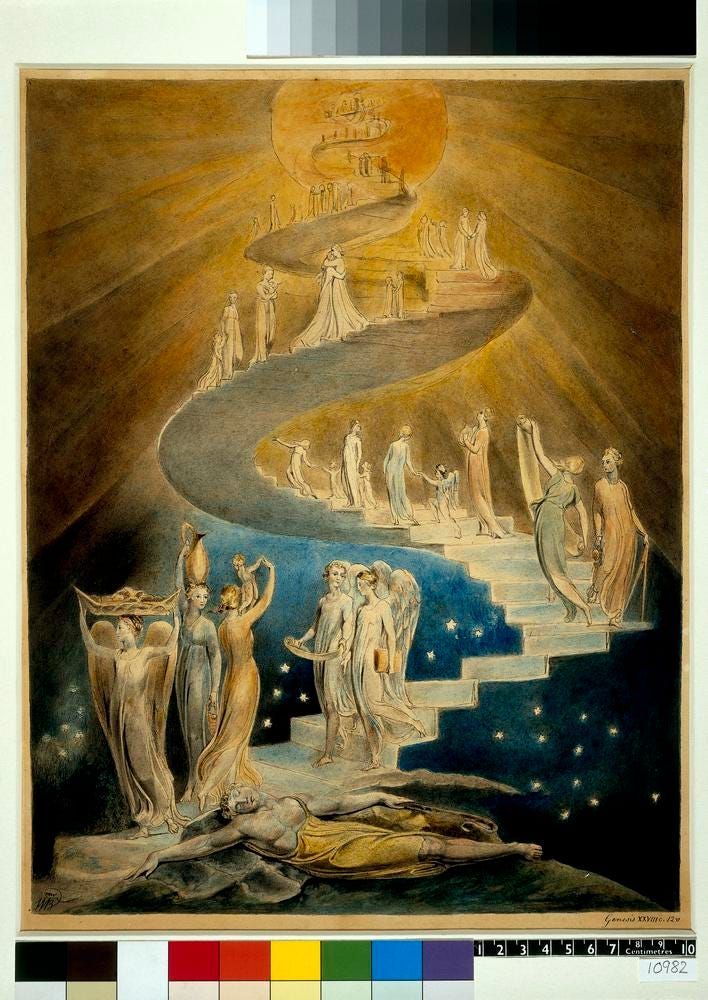
William Blake drew and colored his Jacob’s Ladder between about 1799 and 1806, and it hangs today in the British Museum in London — a modest sheet of pen and ink and watercolor on paper, less than sixteen inches high, with the Genesis reference penciled by Blake himself in the lower right corner. What is worth noticing about the drawing is that it is not, in fact, a ladder. It is a spiral staircase. Broad shallow steps curve up through the picture in a lazy S, rising from a rocky ground at the bottom of the sheet to a golden solar disc at the top, and the disc is not the sun but a doorway, at whose threshold you can just see the last figures crossing over and disappearing into the light beyond. What Blake has drawn all along that winding stair is not a procession of angels but a great throng of persons: women with baskets on their heads, a mother lifting a child, two figures in an embrace, a messenger carrying a scroll. Some are ascending. Some are descending. Two of them, halfway down, meet on the step and greet one another, and the whole spiral is populated with commerce between heaven and earth. At the very bottom of the sheet lies Jacob, his head on the stone and his arms flung out in a yellow-gold robe, deeply asleep, so that he does not know what is happening above him.
William Blake, Jacob's Ladder, c. 1799-1806, pen and gray ink and watercolor, 39.8 × 30.6 cm, British Museum, London (1949,1112.2)
Blake’s reading of the text is remarkably close to the Hebrew. In Genesis 28 Jacob has just deceived his father and stolen the blessing meant for Esau, and he is on the run — heading north from Beersheba to Haran, stopping at a place where the sun has set, taking stones (the plural is important, and the rabbis noticed it) and lying down. In his dream he sees a ladder, סֻלָּם (sullam) set up on the earth. The word is a hapax legomenon, appearing only here in the Hebrew Bible, and although it has been translated ladder since the Septuagint, the root suggests something more like a ramp, a stairway, or a mounted heap. Blake evidently knew this, because he drew a stair. The Lord stands at the top of it and speaks the covenant renewal — I am the Lord God of Abraham thy father, and the God of Isaac — and then, most tenderly, he adds, Behold, I am with thee, and will keep thee in all places whither thou goest, and will bring thee again into this land. Jacob wakes and says two things: Surely the Lord is in this place, and I knew it not, and, This is none other but the house of God, and this is the gate of heaven. He calls the place Bethel.
Now hear how the Gospel this Sunday reads Bethel back to you. In John 1:48, when Jesus meets Nathanael under the fig tree, he says, Verily, verily, I say unto you, Hereafter ye shall see heaven open, and the angels of God ascending and descending upon the Son of man. The Lord takes the whole staircase and locates it in himself. He does not say the angels ascend and descend on the ladder any more, but on him. Jesus Christ is Bethel. Jesus Christ is the gate of heaven. Augustine catches this in his seventh Tractate on the Gospel of John: where does Christ set the ladder now? On himself. Whoever climbs, climbs upon the Son of Man, and whoever descends, descends by the Son of Man. He is the scala — the stairway — between earth and heaven.
Blake was not a churchgoer, and he hated the establishment, and he wrote strange things about Milton and Los and the Zoas that no bishop could parse; but when he read Genesis 28 he saw something the theologians agree with, that the staircase is thronged, that heaven is not empty, that God is not distant, and that the wilderness where the deceiver sleeps on a stone is the same wilderness where angels are running errands overhead.
We should not soften or explain away the test on this point. Jacob has just committed the second worst act of his life, having lied to his blind father, stolen from hia brother, and fled the country. He is running for his life, and in the middle of that flight, at the end of a hard day, on a stone in an anonymous place, God comes to him — not to punish him, not to condition the covenant on better behavior, but to renew the promise. Behold, I am with thee. The staircase is grace, and the staircase came down to him.
Now hear the applications of this verse to life.
First, do not confuse repentance with worthiness. Jacob at Bethel has not yet met his brother, has not yet wrestled with the angel, has not yet paid back a shekel of what he stole; he is on the run, and God does not wait for him to become a better man before renewing the covenant, but comes to him in his flight. Wesley in the Notes on the New Testament observed that mercy runs to meet us while we are still headed the wrong way. God is not waiting for us to clean up our act. He is standing at the top of the stairs speaking our name.
Second, mark the stones. When God has broken through in your life, mark the place, as Jacob poured oil on the stone at Bethel and as the Prayer Book pours oil in baptism and confirmation. Keep the anniversaries; note the days; there are Bethels in your own biography — the year your father died, the night you were converted, the Sunday your first child was baptized, the funeral at which you finally believed the resurrection — and when the wilderness returns, and it will, you will need to remember that God has been in that place before, and you knew it not.
Third,acknowledge the traffic. Blake’s staircase is busy, and the angels are ascending as well as descending, carrying, presumably, our prayers and sighs upward and bringing back mercies and providences, because Hebrews calls the angels ministering spirits sent forth to serve them who shall be heirs of salvation. Modern Christians have grown embarrassed about the angels; do not be embarrassed. The gate of heaven is open, and there is traffic on the stairs.
Fourth, sleep on the stone. That is the imperative. There will be nights when the situation is bad and the sky is dark and the only pillow you have is a stone, and when those nights come you must sleep there and not despair of Bethel, because God has appeared in worse places than this one. Wake in the morning, pour the oil, and go on. The staircase is a spiral, and it is thronged, and Christ is at the top.
Eighth Sunday after Pentecost, Proper 11, Year A. Track 1 readings from lectionarypage.net: Genesis 28:10-19a; Psalm 139:1-11, 22-23; Romans 8:12-25; Matthew 13:24-30, 36-43. Artwork: William Blake, Jacob’s Ladder, c. 1799-1806, pen and gray ink and watercolor, 39.8 × 30.6 cm, British Museum, London (1949,1112.2). Augustine, Tractates on the Gospel of John, Tractate 7. Wesley, Notes on the New Testament.