Love Lifts the Body; Thoughts on Romans 12 and Van Gogh
A note on the Epistle for the Fourteenth Sunday after Pentecost — Proper 17A, Year A — 30 August 2026 -- Romans 12:9-21
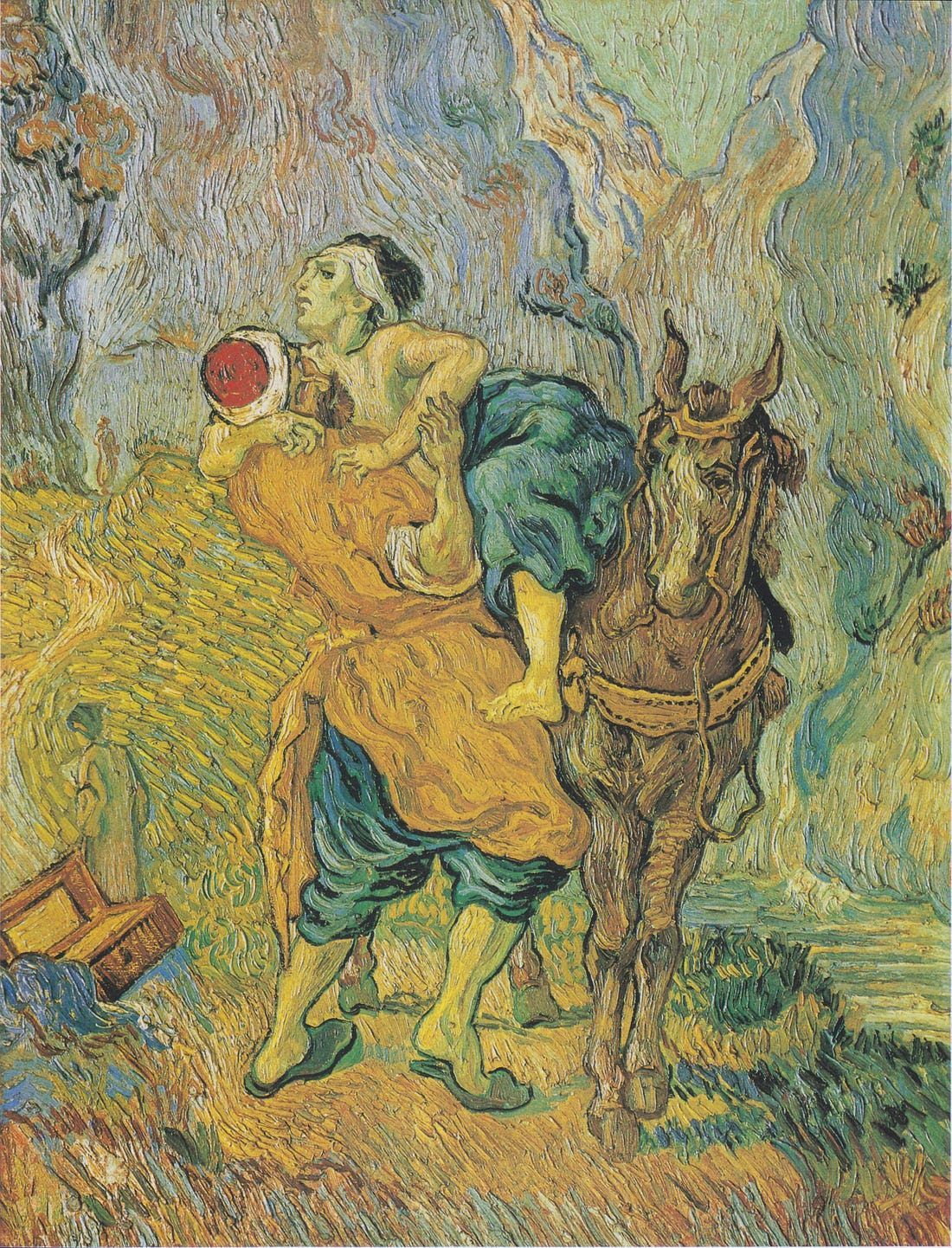
Vincent van Gogh, The Good Samaritan (after Delacroix), (May 1890), Kröller-Müller Museum Otterlo
Aug 27, 2026
Walk into the Kröller-Müller Museum in Otterlo, in the woods of the Netherlands, and there you will find Van Gogh’s The Good Samaritan (after Delacroix). Oil on canvas, about two feet by two and a half, it was painted in May 1890 at the asylum in Saint-Rémy-de-Provence, two months before Van Gogh shot himself in an Auvers wheat field. He copied it from a print by Delacroix because he wanted to study a master, and because he wanted to preach.
Vincent van Gogh, The Good Samaritan (after Delacroix), (May 1890), Kröller-Müller Museum Otterlo
Two figures fill the vertical middle. The Samaritan stands and strains, the wounded man held against his chest. The Samaritan’s face is pale and green-shadowed with effort, dark-haired, a white cloth tied around his forehead. His mouth is open. His eyes are lifted. His upper body is bare. A golden-yellow robe wraps his waist. Blue leggings show at the calves. He heaves the wounded man toward the back of a waiting mule.
The wounded man is carried face-to-chest. Both his arms are around the Samaritan — one hooked around the neck, the hand hanging pale in front; the other draped around the Samaritan’s right side, fingers spread. His head rests at the Samaritan’s left shoulder in profile, a small red disk of a face wrapped in a white bandage. His body is essentially naked against the yellow robe. The mule stands to the right, reddish-brown, harnessed in yellow, a brilliant blue saddle-blanket over its back. To the lower left, an emptied coffer lies on its side. A length of blue cloth spills out of it onto the ground. The robbers have gone. What they did not want they threw down.
In the middle distance, small on the winding rocky path, two figures walk away. Van Gogh has painted them going. They are the priest and the Levite. They passed by on the other side. They are already around the bend.
Behind everything, the walls of a stone canyon swirl in Van Gogh’s late brushwork. A narrow triangle of pale green sky opens at the top. The world of Provence has become the road from Jerusalem to Jericho.
Now consider Van Gogh’s Samaritan. He is not saying anything. He is not making a speech about mercy. He is doing the physical work of lifting a body he does not know onto an animal he owns. His whole weight is under the wounded man’s weight. That is the painting’s argument.
Now go to the Epistle Sunday’s reader will read. Romans chapter twelve, verse nine. Let love be genuine. The Greek is anupokritos. Un-hypocritical. Not stage love. Not the love of the actor who wears the mask of philia while the eyes behind the mask calculate. Paul begins the paragraph with two words. Genuine love. Then he spends thirteen verses describing what genuine looks like when you take the mask off.
Abhor what is evil, hold fast to what is good. Two verbs, both physical. Do not merely dislike evil. Recoil from it. Do not merely admire the good. Glue yourself to it.
Love one another with brotherly affection. Outdo one another in showing honor. Paul makes it a contest. In the world we outdo one another in status. In the Church we outdo one another in honoring the person next to us. Do not be slothful in zeal, be fervent in spirit, serve the Lord. Rejoice in hope. Be patient in tribulation. Be constant in prayer. Contribute to the needs of the saints. Practice hospitality. The Greek verb behind practice hospitality is philoxenia. Love of the stranger. Not entertaining friends. Loving the one you have not met.
Paul is not finished. Bless those who persecute you. Bless and do not curse them. That instruction is not aimed at some future season of martyrdom. Read it at the level of the parish. Bless the neighbor who complained about your fence. Bless the vestryman who spoke against you last month. Bless the sister-in-law who is not speaking to you at all. Bless. Do not curse.
Rejoice with those who rejoice. Weep with those who weep. That is one of the great two-sentence rules of the Christian life. Paul asks you to inhabit another person’s mood as if it were your own. This is what Van Gogh’s Samaritan is doing on the road. He is weeping with the man who is bleeding.
Live in harmony. Do not be haughty. Do not repay evil for evil. So far as it depends on you, live peaceably with all. The clause so far as it depends on you is exact. Sometimes the other party will not have peace. Paul knows. But do not let it be you who breaks the peace.
Never avenge yourselves, beloved. Vengeance is God’s business. If your enemy is hungry, feed him. If he is thirsty, give him drink. Do not be overcome by evil. Overcome evil with good.
Overcome evil with good. That is the last sentence of the passage. Read it twice.
Chrysostom, preaching this passage in his twenty-second homily on Romans, says Paul does not merely tell you not to hate your enemy. He tells you to feed him. Because the mind that plans a meal for the enemy cannot at the same time be plotting his ruin. The act works on the heart.
Now, five applications.
First, take off the mask. Ask whether the love you offer at coffee hour is anupokritos or theater. Do not fake affection. Practice it until it becomes real. The saints did not begin with warm hearts. They began with cold hearts and warm hands.
Second, keep a list. Write down three people this week who irritate you. Not the ones who wounded you catastrophically. The small ones. The pew neighbor who hums, the driver who cut you off, the parishioner who always corrects you. Then bless each of them by name in your daily prayers. Do this for a week. Something in you moves.
Third, find the coffer on the road. Where in this parish, this street, this family, is there a spilled box? A neighbor freshly widowed. A child in a hard marriage. A colleague drinking again. Do not walk around the bend like the priest and the Levite. Get off your mule. Put your weight under the weight.
Fourth, feed the one you do not want to feed. If your enemy is hungry, said Paul, feed him. That may mean a meal. It may mean a Christmas card sent when you owe none. It may mean forwarding the job posting to the colleague who lied about you. Do not be overcome by evil. Overcome it.
Fifth, watch what Van Gogh watched. He copied a Delacroix in an asylum because he needed to preach to himself. He knew he was breaking. Paul had known worse. The Gospel had held them both. If you find yourself weakened this week — by illness, by grief, by the wearing of small unkindnesses — copy a master. Read Romans 12 slowly, twice a day. Let Paul’s sentences do their work on you the way the Samaritan’s arms did their work on the wounded man.
There is a wounded man on the road you will walk this week. He may be in your pew. He may be in your mirror. Lift him.
Lectionary: Proper 17, Year A — Exodus 3:1-15; Psalm 105:1-6, 23-26, 45c; Romans 12:9-21; Matthew 16:21-28 (Track 1). Sources: Vincent van Gogh, The Good Samaritan (after Delacroix), May 1890, oil on canvas, 73 x 60 cm, Kröller-Müller Museum Otterlo KM 111.041; John Chrysostom, Homily 22 on Romans; Jeremy Taylor, Holy Living; BCP Collect for Peace.