The Killer at the Altar: Sermon thoughts for Sunday, June 21, 2026
Musings on the Gospel for the Fourth Sunday after Pentecost — Proper 7, Year A
The Killer at the Altar: Sermon thoughts for Sunday June 21, 2026
Author’s note: I begin my sermon preparation on Sunday evening — working through each of the texts and experimenting with ideas, images and meaning as time permits across the week. I’ve been encouraged to write up my notes to share with the congregation, so they can see how we get to Sunday morning’s sermon from the Lectionary reading.
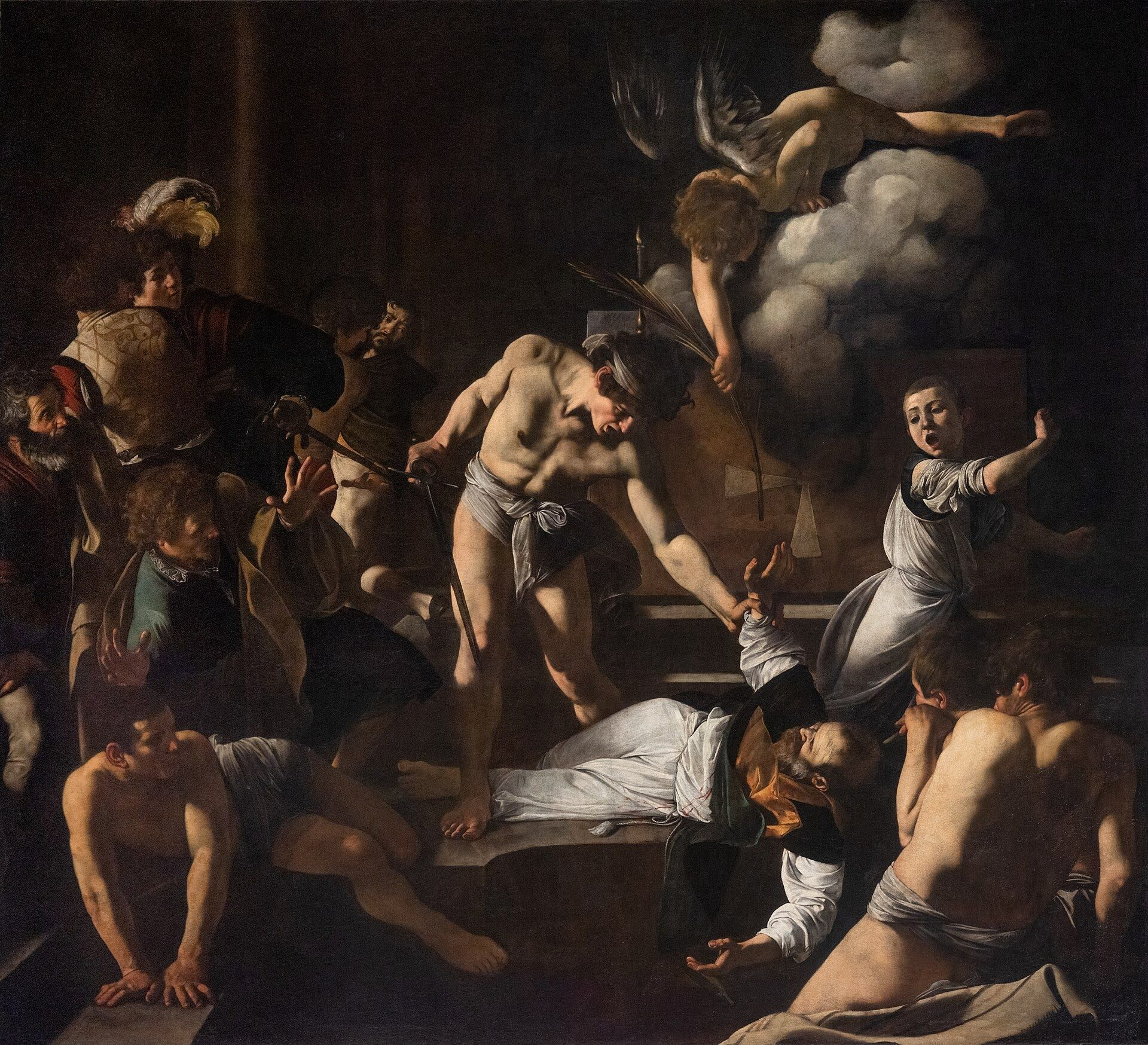
If you walk into the church of San Luigi del Francesi in Rome and turn left toward the Contarelli Chapel, you find three Caravaggios on three walls. To see then, you have to drop a euro coin into a meter, which turns on a light on a timer. As light brightens the room you see the Calling of St. Matthew on the left; the Inspiration of St. Matthew over the altar; and the Martyrdom of St. Matthew on the right. Caravaggio painted them between 1599 and 1600, in his late twenties, for executors who wanted a complete life of the saint on the chapel walls. The three pictures hang in the order of a life. A call. A book. A killing.
The Roman who came in for Mass walked past the killing to get to the rail.
That is the picture I want to explore for this Sunday’s Gospel. Our reading from Matthew 10 is a hard passage. Jesus is sending the Twelve out on their first mission, and he does not soften the assignment. He tells them they will be hated for his name’s sake. He tells them they will be brought before governors and kings. He tells them — and this is the verse the modern parish least wants to hear read aloud — that he came not to send peace, but a sword.
That verse is verse 34. It troubles us because we have been catechized to expect from Jesus a calm voice and a soothing hand. He is, after all, the Prince of Peace. He has just blessed the peacemakers in the Sermon on the Mount. We come to Sunday services partly because we expect to find peace there. And now, halfway through Matthew, we are told that the Lord we are following has come with a sword.
Calvin will not let us read this away. Neither will Luther. The careful expositors will tell you that Jesus is not commending violence. He is describing an effect. The Word he brings is not a soft word. It cuts. It cuts between truth and falsehood, between the kingdom and the world, and sometimes — Jesus says this plainly — it cuts between father and son, mother and daughter, and through the middle of a household. The sword is the natural consequence of telling the truth in a fallen world.
Caravaggio paints exactly that consequence.
The painting is enormous. Three hundred and twenty-three centimeters tall by three hundred and forty-three centimeters wide. Matthew has been struck down at the altar he himself was serving. He is on his back, brought low. A naked, muscular figure stands over him with a sword in his right hand, raised for the death blow. The killer’s left hand is reaching down for the apostle’s wrist. He means to finish the job.
The killer in Caravaggio’s painting has a name. Tradition, preserved in Jacobus de Voragine’s Golden Legend, tells us that Matthew had carried the gospel to Ethiopia, where he converted King Egippus and his daughter Iphigenia. Iphigenia took a vow of virginity and entered the company of consecrated women. When Egippus died, his successor, King Hirtacus, desired her for his wife and asked Matthew to release her from her vow. Matthew refused. He would not soften the word he had given. Hirtacus sent a soldier to the altar, and the apostle was struck down as he celebrated the Eucharist. The man with the sword is no anonymous brigand. He is a king’s instrument, sent because a priest would not bend the gospel to a ruler’s appetite.
Around them, the worshippers of the church recoil. A boy in the corner is screaming. Newly baptized men and women in white are pulling away from the altar steps. A single shaft of light — Caravaggio’s invention, the light that made his name — falls from the upper left and picks out the killer’s shoulder, the apostle’s outstretched hand, and one more thing.
An angel is leaning down out of the cloud. The angel is offering Matthew a palm. The palm is the ancient Christian sign of martyrdom. It is the wage of the apostle who has died for the Lord he served.
The blade is falling in the same shaft of light in which the palm is being offered.
That is what I want the people of Shepherd of the Hills to see on Sunday. Two things happening at the same instant. A man being killed for his Lord. A reward being placed in his hand by his Lord. The sword and the palm are not opposites in this picture. They are simultaneous. They are part of the same Gospel.
Here is the pastoral point. The peace Jesus offers in this passage is not peace with the world. He says so plainly. He says he came to bring a sword that will cut between members of the same family. The peace he offers is something different. It is peace with God.
Most Episcopalians have been told their whole lives that they can have both peaces at once. That following Jesus is socially comfortable. That the Gospel will not cost them their friendships, their family relationships, their standing at work. The text in front of us this week tells the truth they have not been told. There is a peace on offer that holds, but it is not peace with the world. It is peace with the Father who counts every hair on the disciple’s head and sees every sparrow that falls.
George Herbert understood this. The poem “Aaron,” in The Temple, is the priest’s confession that he is “profaneness in his head” and “defects and darkness in his breast,” and yet, because Christ is in him and dressing him, he is “well drest.” The herald of the costly Gospel is also the disciple under the same sword he is preaching about. The rector who steps into the pulpit on Sunday with Matthew 10 in front of him would do well to read Herbert the night before.
So what does the sermon ask of the congregation?
First, that they not soften the text. The Lord Jesus said what he said. He did not come to send peace on earth. He came to send a sword.
Second, that they look at the painting — or imagine it — and see the two things happening at once. The blade. The palm. The killing. The reward. The disciple does not have to choose between them. They are part of the same moment.
Third, that they ask themselves which peace they have been seeking. The world’s peace will not hold. It is already failing them. The Father’s peace will. It is the only thing on offer this Sunday that will.
Caravaggio painted his own face into the picture, just behind the killer’s shoulder, bearded, watching. He insisted on being a witness. He insisted that the viewer be one too. We will be a witness to the same scene on Sunday morning, at the same altar where Matthew was killed, in spirit if not in fact. The question is what we will see, and what, when we have seen it, we will go home and do.
Lectionary: Genesis 21:8–21 · Psalm 86:1–10, 16–17 · Romans 6:1b–11 · Matthew 10:24–39 (RCL Track 1, Episcopal use), via The Lectionary Page. On the Contarelli Chapel cycle, the standard reference is Howard Hibbard, Caravaggio (Westview, 1983). George Herbert, “Aaron,” in The Temple (1633); see John Drury, Music at Midnight: The Life and Poetry of Georg