Give Ye Them to Eat: The Feeding of the 5000 Seen Through Jacopo Tintoretto's Miracle of Loaves and Fishes
Jacopo Tintoretto, The Miracle of the Loaves and Fishes, (1545–50) The Metropolitan Museum of Art, New York
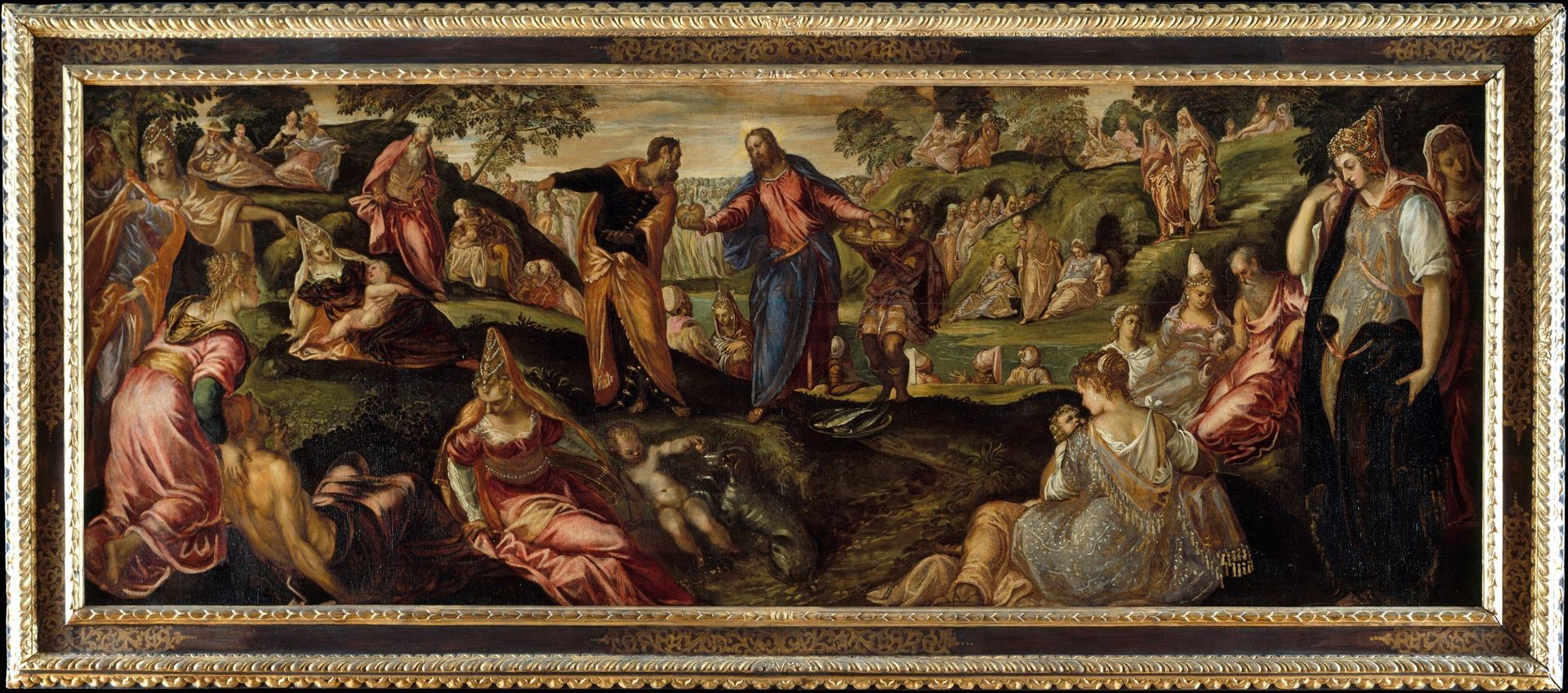
Jacopo Tintoretto painted The Miracle of the Loaves and Fishes in Venice around 1545 to 1550. The canvas is oil on linen, five feet high and more than thirteen feet across, and it hangs today in the Metropolitan Museum of Art in New York. The wide, horizontal shape is Venetian. Tintoretto painted it to run along the wall of a portego, the long central hall of a palace, or the lateral wall of a chapel. It was made to be looked at as you walked past.
Jacopo Tintoretto, The Miracle of the Loaves and Fishes, (1545–50) The Metropolitan Museum of Art, New York
Look at what he has put in the middle. Christ stands facing to his right in a pink tunic and a deep blue cloak, a gold halo around his head, dark hair and beard. In his left hand he holds a single round loaf of bread. His right arm is stretched out at his side, palm open, in the gesture of blessing. On the ground behind him lies a shallow dark plate holding three or four silver-gray fish. The fish are what the boy brought. Tintoretto has put them under Christ’s feet.
On Christ’s right stands an apostle in a black doublet with a gold-orange mantle wrapped at his hips. He is bearded, powerfully built, and turned in toward Christ, one hand extended, listening. On Christ’s left, a younger apostle, bare-chested with a russet cloth wrapped around his hips, stoops and holds up a shallow woven basket of loaves toward Christ. This is the whole engine of the picture. One apostle receives the word. Another lifts up the inventory. Christ blesses. The fish are on the ground.
Now look at who Tintoretto has put in the crowd. On the hillside behind and on both flanks of Christ, ranged in tiers up the slope, are women in Venetian silk gowns. Not five thousand ordinary men on the grass. Not a peasant crowd. Venetian gentlewomen with pearls and elaborate hair, seated on the hill as if for a summer afternoon at the park. A few older bearded men are scattered among them, but the crowd is overwhelmingly female and overwhelmingly patrician.
The foreground continues the theme. At the far left, a woman in a pink gown with a green underskirt sits with her hand on the shoulder of a half-naked man reclining beside her. In the center foreground, a woman in a coral gown with a pointed hood sits on the grass, and in front of her a naked child kneels, one hand reaching down toward a dark shape on the ground that reads as one of the fishes. On the right, a woman in a silvery-cream dress leans back holding a small child in her lap. Beside her stands a tall woman in a coral mantle with a pearl tiara, and another woman in silver beside her. The two rightmost women look on with the distance of a portrait — the ladies who paid for the picture, or their friends.
Tintoretto has painted the five thousand as the whole city of Venice arranged on a hill. He is not being irreverent. He is telling you the miracle is not for peasants only. The Lord fed everyone. The gentlewoman in silk needs the Bread as much as the beggar. The child in the arms of the mother needs it. The elderly patriarch further up the slope needs it. Nobody at Shepherd of the Hills is exempt. Nobody at Saint Mark’s Basilica in Venice was exempt either.
Now turn to the Gospel. And when it was evening, his disciples came to him, saying, This is a desert place, and the time is now past; send the multitude away, that they may go into the villages, and buy themselves victuals. The disciples are being reasonable. It is evening. There is no food. Send them home. The Lord answers with a command. But Jesus said unto them, They need not depart; give ye them to eat.
Give ye them to eat. The disciples’ request is reasonable and the Lord’s answer is not. The disciples answer with the inventory. We have here but five loaves, and two fishes. And the Lord answers with a second imperative. Bring them hither to me.
Cyril of Alexandria, on the parallel account in Luke, sees exactly what has happened. The Lord takes the apostles’ inadequate resources and makes them the vehicle of the miracle. He does not multiply the bread out of nothing. He multiplies the boy’s bread through the hands of the twelve. What the apostles bring is what he blesses. That is the whole doctrine of the Christian ministry in one sentence.
The Prayer of Humble Access knows it. We do not presume to come to this thy Table, O merciful Lord, trusting in our own righteousness, but in thy manifold and great mercies. We are not worthy so much as to gather up the crumbs under thy table. Cranmer took the words of the Syrophoenician woman and set them before the Bread. He wanted every communicant to hear the crumbs and to remember the twelve baskets of fragments. Article XXVIII is precise on the substance. The Bread which we break is a partaking of the Body of Christ. Not a symbol. A partaking. The boy handed over the loaves. The apostles carried them. Christ blessed. The five thousand ate. Every Sunday morning at every altar in the Anglican world, that action is done again.
The applications.
First, bring what you have. The apostles brought five loaves and two fishes and were embarrassed by them. The Lord did not scold. He blessed. Your gifts are inadequate. Your prayers are inadequate. Your Sunday School class is inadequate. Your visits to the sick are inadequate. Bring them anyway. What Christ blesses does not stay inadequate for long.
Second, do not send the crowd away. The temptation is to solve the crowd by dispersing it. Send them away. The Lord’s instinct runs the other way. He gathers, he seats, he feeds. When the parish grows and the resources feel thin, do not begin by rationing. Begin by feeding. The multiplication happens after the feeding starts, not before.
Third, count the fragments. The Lord had the disciples gather up what was left. Twelve baskets. Every Communion service ends with the ablutions and the reverent consumption of what remains. This is not fussy ritual. It is the recognition that the fragments matter. Every Sunday something of the meal is left over. It is your job to gather it. The parishioner still hungry after the service; the couple still troubled after the sermon; the child still lonely after the coffee hour. Gather the fragments. Feed them again.
Fourth, give them the Bread. That you must do. You have no better food to give a congregation. You cannot fix their marriages by advice or their doubts by a logical argument. You can put the Bread in their palm, and Christ has already blessed it. Cyril knew it. Cranmer knew it. Tintoretto’s noblewomen on the hillside are still waiting for it. Give it.
Bring the loaves. Bless them. Break them. Serve.
Tenth Sunday after Pentecost, Proper 13, Year A. Track 1 readings from lectionarypage.net: Genesis 32:22-31; Psalm 17:1-7, 16; Romans 9:1-5; Matthew 14:13-21. Artwork: Jacopo Tintoretto, The Miracle of the Loaves and Fishes, c. 1545–50, oil on canvas, 154.9 × 407.7 cm, The Metropolitan Museum of Art, New York (13.75). Cyril of Alexandria, Commentary on Luke, on the parallel account of the feeding. Prayer of Humble Access and Article XXVIII from the Book of Common Prayer.